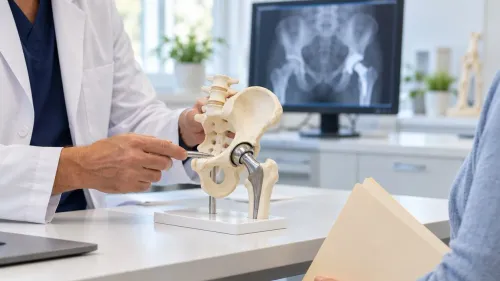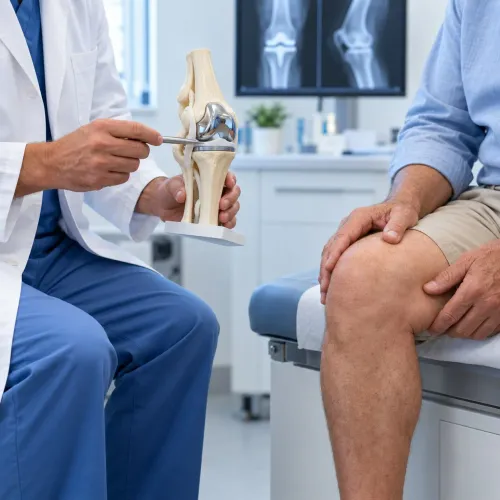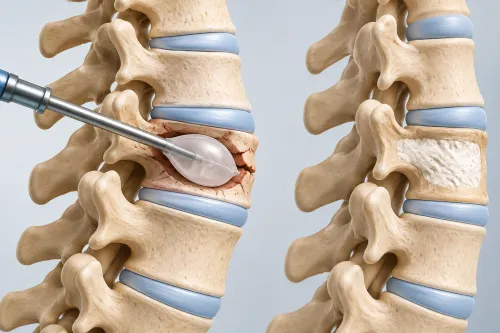

Recurring joint pain deserves more than a scan review or a request for stronger pain relief. Prepare a clear symptom record, identify warning signs, and ask how the history, examination and test results support a diagnosis before you discuss treatment or surgery.
Key takeaways
- Seek urgent care for a hot, swollen joint with sudden severe pain.
- Ask which diagnosis the examination supports and what evidence would change it.
- Choose tests only when their results could alter your treatment plan.
- Set a time limit for non-surgical treatment before reviewing the next step.
Is This Pain an Orthopaedic Appointment or an Urgent Problem?
A hot swollen joint with sudden severe pain needs urgent medical assessment, not a routine orthopaedic appointment. Doctors must consider septic arthritis and crystal arthritis, and septic arthritis symptoms can occur without fever or a raised temperature.
Seek urgent care first if you have:
- A hot, swollen, acutely painful joint
- A visibly deformed joint or pain after major trauma
- Sudden inability to bear weight
- New numbness or weakness
- A pale, blue, cold limb, or a missing or markedly weaker pulse, suggesting blood-vessel compromise
The assessment may require joint aspiration. The fluid can be tested for cell count, crystal analysis, Gram stain and culture to distinguish infection from gout or another crystal arthritis.
For recurring joint pain without these warning signs, book a planned consultation and bring a written timeline covering:
- When each flare began and how long it lasted
- Pain at rest or at night, morning-stiffness duration, and activity triggers
- Locking, catching, giving way and visible swelling
- Previous injuries, treatments tried, current medicines and relevant medical conditions
This record helps the surgeon decide whether the pattern suggests osteoarthritis, inflammatory arthritis, tendon or ligament injury, instability, nerve-related pain or referred pain. Ask whether physiotherapy, strengthening, aerobic exercise or activity modification is safer than simply resting the joint.
What Diagnosis Does the History and Examination Actually Support?
The history and joint examination should support a diagnosis before any scan is allowed to explain every symptom. Ask, “Is the pain coming from the joint itself, or from a nearby tendon, bursa, muscle, spine or nerve?” A careful joint examination includes range of motion, stability, swelling, strength, gait, and nerve and blood-vessel function.
| Pattern | Questions and clues | Examination focus |
|---|---|---|
| Osteoarthritis | Is pain activity-related, in someone aged 45 or older, with morning stiffness lasting no more than 30 minutes? | Movement restriction, crepitus, tenderness and alignment |
| Inflammatory arthritis | Is there persistent swelling, prolonged morning stiffness, or pain in several small hand or foot joints? | Synovitis, warmth, symmetry and other affected joints |
| Tendon or ligament injury | Does a specific movement, load or previous injury trigger pain? | Localised tenderness, resisted strength and ligament stability |
| Instability | Does the joint give way, shift or feel unreliable? | Laxity, alignment, gait and functional movement |
| Nerve compression or referred pain | Are there tingling, numbness, weakness, back or neck symptoms? | Reflexes, sensation, muscle power and spine assessment |
| Previous fracture | Did symptoms begin after the fracture, immobilisation or altered walking pattern? | Deformity, alignment, range and load tolerance |
Persistent synovitis, prolonged morning stiffness, small-joint symptoms or fatigue, fever and weight loss warrant discussion of a rheumatology referral. NICE recommends urgent specialist assessment for suspected persistent synovitis even when inflammatory markers or rheumatoid-factor tests are normal.
For a typical osteoarthritis diagnosis, clinical assessment often suffices without routine imaging. Ask which finding would change treatment before accepting an abnormal scan as the cause.
Which Test Would Change the Treatment Plan?
Ask what treatment decision each test could change before requesting it. For chronic knee pain, an X-ray for joint pain is usually the initial imaging choice when imaging is needed; MRI knee pain is not automatically the next step. An MRI can reveal meniscal or cartilage abnormalities that are incidental and unrelated to your symptoms.
| Test | What it can show | What it cannot establish |
|---|---|---|
| X-ray | Arthritis, alignment, bone narrowing and many fractures | Tendon, nerve, early cartilage or most meniscal problems |
| Ultrasound | Selected tendons, bursae, fluid and needle placement for guided procedures | Deep structures and the full extent of cartilage or marrow damage |
| MRI | Soft tissue, cartilage, marrow, nerves and occult injury | That every abnormality causes your pain |
| CT scan | Complex bone anatomy and fracture detail; useful in CT scan orthopaedics | Most tendon or ligament problems, without radiation exposure |
| Blood tests | Evidence supporting inflammation or systemic disease | The exact source of pain by themselves |
| Joint-fluid analysis | Infection, crystals, cell count and inflammation | Tendon, bone or nerve causes outside the joint |
For ultrasound joint pain, ask whether the suspected tendon, bursa or fluid collection is accessible and whether the result changes treatment. A hot, swollen, acutely painful joint needs urgent discussion of aspiration for cell count, crystal analysis, Gram stain and culture; no fever does not safely exclude infection.
Ask, “What will we do differently if this test is positive or negative?”
Which Non-Surgical Options Are Worth Trying, and for How Long?
Before an irreversible procedure, ask which non-surgical option to try, what improvement to measure, and how long to continue it. For knee or hip osteoarthritis, exercise remains core treatment even when it causes manageable pain. Ask how physiotherapy for joint pain, strengthening, aerobic exercise and activity modification will be tailored and progressed safely.
| Option | Question to ask | Key trade-off |
|---|---|---|
| Physiotherapy and exercise | What programme and progression fit my strength, pain and joint? | Rest alone can worsen weakness; excessive loading can trigger a flare. |
| Weight management | If appropriate, what could 5% versus 10% weight loss change? | Weight loss osteoarthritis benefits vary, so set a functional target. |
| Brace or walking aid | Would a brace, stick or frame improve stability and walking? | Incorrect fitting can alter gait or increase pressure elsewhere. |
| Heat or ice | Which should I use, for how long, and before or after exercise? | Relief is temporary and does not replace rehabilitation. |
| Medication | Can I try a topical NSAID first? If oral treatment is considered, what are my NSAID risks? | Discuss gastrointestinal, kidney, liver and cardiovascular risks, pregnancy, interactions, dose, duration and gastroprotection. |
| Injection | What is the plan after a corticosteroid injection? | Relief often lasts about 2 to 10 weeks; ask how frequently it is safe to repeat. |
Ask why hyaluronic acid is offered despite NICE guidance against routine use, including evidence, cost and alternatives. Before arthroscopy, clarify whether you have true mechanical locking or only clicking, vague catching or a degenerative meniscal finding. Ask what happens if symptoms persist after each trial.
When Is Surgery, Referral or a Second Opinion Reasonable?
A joint surgery decision should rest on symptoms and lost function, not a frightening scan. During an orthopaedic surgeon consultation, ask which objective limitation—such as inability to climb stairs, walk a set distance, sleep, work or use the joint—justifies surgery, and which non-surgical treatment options were ineffective or unsuitable.
| Option | What to ask | Why it matters |
|---|---|---|
| Surgery | What improvement is realistic, which complications relate to my health, and what recovery demands will I face? | A severe X-ray finding alone does not predict meaningful benefit. |
| Deferral | What happens if I wait six or 12 months, and which warning signs would change that plan? | Delay may be reasonable, but you need to know the consequence and review point. |
| Second opinion | Is the diagnosis certain, and what alternatives remain? | It tests the reasoning, not just the scan. |
Request a second opinion for joint pain when the diagnosis remains uncertain, pain is disproportionate to structural findings, the recommendation rests mainly on imaging, or the procedure is irreversible. Ask the independent specialist to review:
- The diagnosis supported by your history and examination
- Non-operative alternatives and why any were unsuitable
- Expected benefit, complication risk and recovery demands
- The outcome if you defer surgery
UR Orthopaedic Clinic can organise these questions around examination findings, test interpretation and a staged plan, including referral when symptoms suggest rheumatology, neurology or another service rather than orthopaedic care.
Related services
Total Hip Replacement At our orthopaedic clinic, we offer advanced Total Hip Replacement surgery for patients suffering from severe hip arthritis, joint damage, or chronic... View service → |
Reverse Shoulder Replacement At our orthopaedic clinic, we offer advanced Reverse Shoulder Replacement surgery for patients with severe shoulder arthritis, rotator cuff tear... View service → |
Frequently asked questions
When is recurring joint pain an urgent problem?
A hot, swollen joint with sudden severe pain needs urgent medical assessment because septic arthritis and crystal arthritis must be considered. Septic arthritis can occur without fever.
What should you ask about the diagnosis?
Ask which diagnosis the history and physical examination support, what findings point to it, and which alternative diagnoses remain possible.
Which test should you have for recurring joint pain?
Ask what decision each proposed test could change. A test is most useful when its result will alter treatment, referral or the need for further investigation.
How long should you try non-surgical treatment?
Ask which non-surgical options fit your diagnosis, how to use them, what improvement to measure and when to review the plan if symptoms continue.
When is surgery, referral or a second opinion reasonable?
Discuss surgery when symptoms, examination findings and imaging support it and non-surgical care has not met its goals. Ask for referral or a second opinion when the diagnosis is uncertain, treatment risks are significant or the proposed procedure is unclear.
Related services
Elbow Replacement At our orthopaedic clinic, we offer advanced elbow replacement surgery for patients suffering from severe arthritis, complex fractures, or joint... View service → |
Total Knee Replacement At our orthopaedic clinic, we provide advanced Total Knee Replacement surgery for patients suffering from severe knee arthritis, joint deformity, or... View service → |
Total Shoulder Replacement At our orthopaedic clinic, we provide advanced Total Shoulder Replacement surgery for patients suffering from severe shoulder arthritis, joint... View service → |