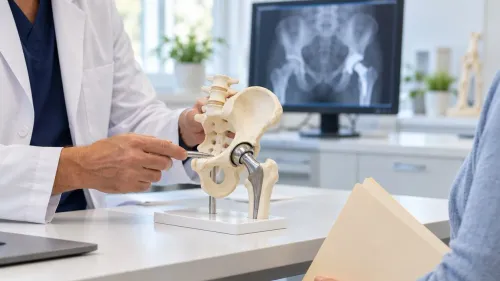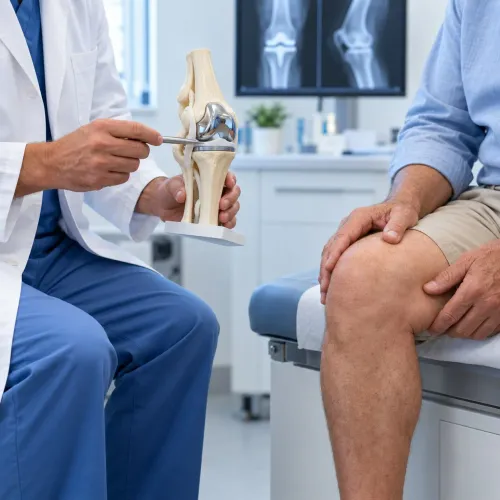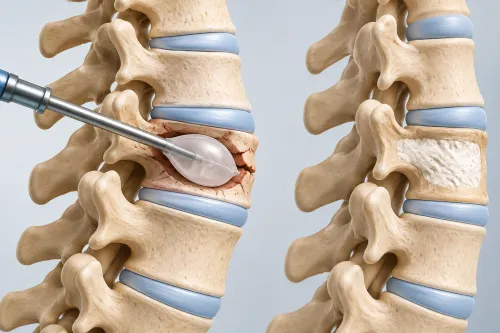
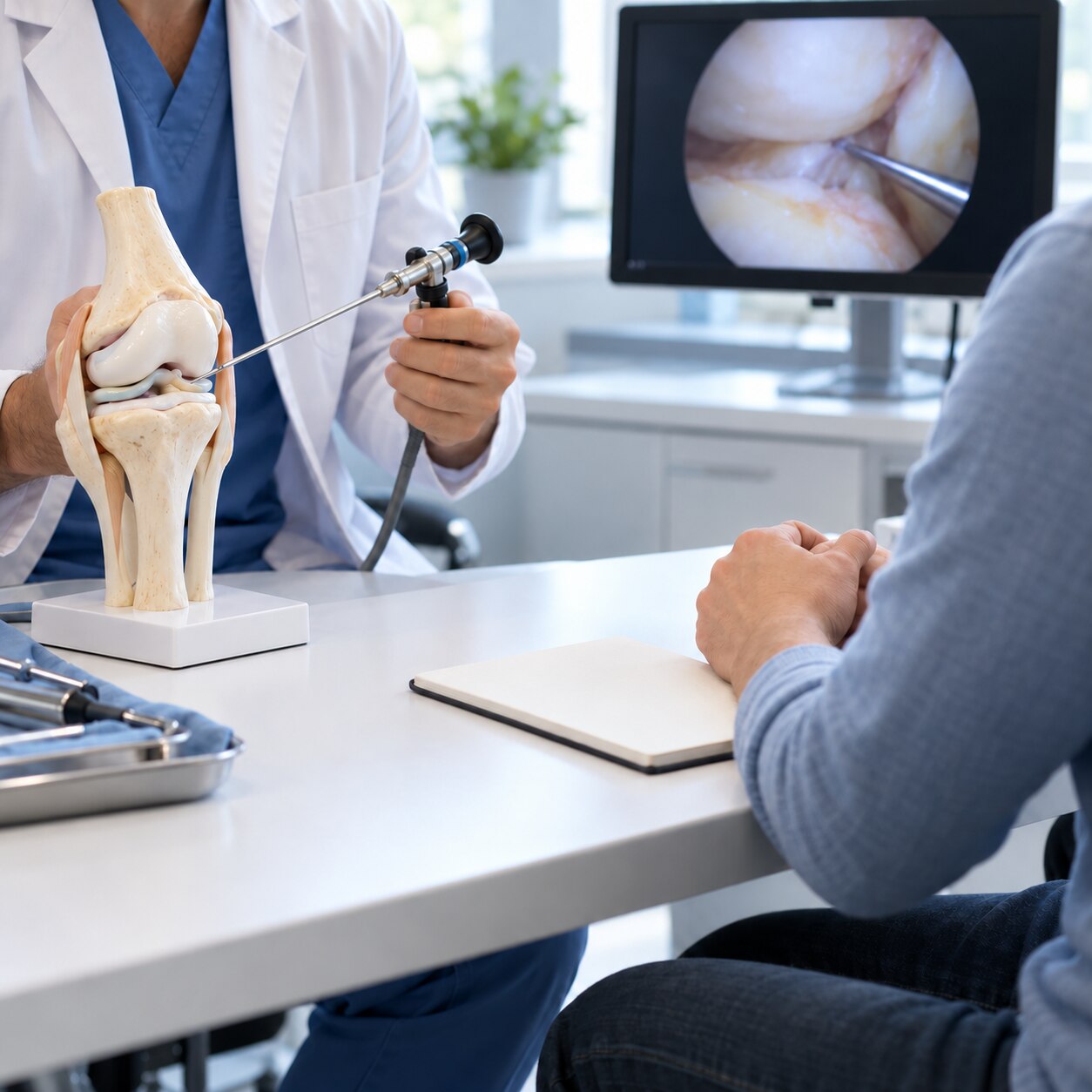
An MRI finding does not tell you whether arthroscopy is the right treatment, which operation will be performed, or how much rehabilitation it will require. Use the questions below to connect your diagnosis to a specific procedure, compare expected benefits with alternatives, and verify the surgeon, facility, risks and recovery plan before you consent.
Key takeaways
- Ask which structure causes your symptoms and how examination supports imaging.
- Confirm the exact operation and the plan if surgery reveals a different problem.
- Define non-surgical treatment success using measurable pain, movement and activity goals.
- Verify the surgeon’s personal experience, facility standards and your recovery responsibilities.
Does my diagnosis give arthroscopy a clear job to do?
Arthroscopy has a clear job only when your symptoms, examination and imaging point to the same structure. Ask, “Which structure is causing my symptoms, and how do the examination and symptom pattern support the scan?”
Ask whether the problem is one of these:
- A traumatic meniscus tear, ACL injury, labral tear, loose body or focal cartilage defect
- A rotator cuff tear that needs repair rather than treatment for unrelated shoulder pain
- Degenerative change without a specific mechanical or traumatic problem
| Finding | Ask the surgeon to explain | Warning sign |
|---|---|---|
| Meniscus tear or cartilage defect on MRI | Which symptom it explains and what benefit surgery adds | The scan is abnormal but your examination is reassuring |
| Clicking or catching | Whether the joint is actually locked and cannot fully extend | Intermittent noise is being treated as true locking |
| Knee osteoarthritis | What specific problem arthroscopy will correct | Lavage or debridement is offered for “wear and tear” alone |
Ask, “What symptom will this operation treat, and what finding would make you recommend against surgery?” An MRI abnormality alone does not prove that surgery will help; meniscal tears and cartilage defects occur in people with little pain.
For a degenerative meniscus tear without true locking, compare surgery with observation and a structured exercise programme. Ask for a measurable goal, such as walking farther or relieving a particular locking symptom. Request a plain-language diagnosis and a second opinion if the proposed operation does not match your symptoms.
What exact operation will you perform, and what will you do if the finding differs?
Arthroscopy names the access method, not the treatment. Ask, “What exact operation will you perform?” The answer should identify meniscus repair, partial meniscectomy, ligament reconstruction, cartilage treatment, loose body removal, labral repair, rotator cuff repair, debridement or another procedure.
| Option | Tissue effect | Recovery and trade-off |
|---|---|---|
| Meniscus repair versus partial meniscectomy | Repair preserves tissue; meniscectomy removes the damaged portion | Repair often means longer limits on knee flexion, weight bearing and rehabilitation; meniscectomy may speed early recovery but can increase joint loading |
| Rotator cuff repair versus debridement | Repair reattaches the tendon; debridement trims damaged tissue without restoring the tendon | Repair requires longer protection and rehabilitation; debridement may recover sooner but offers less benefit when tendon function is the problem |
For a meniscus tear, ask why preserving and repairing the tissue is suitable or unsuitable in your case. For a rotator cuff tear, ask what makes repair preferable to debridement and what happens if the tendon cannot be repaired.
Ask these questions before signing consent:
- If the finding differs from the scan, will you stop, perform loose body removal, carry out limited debridement or proceed with another treatment?
- Does the consent form permit an alternative procedure, and under what finding would you perform conversion to open surgery?
- What benefit, durability and recovery time should I expect from each option?
Ask whether a failed repair or progressing cartilage damage could lead to later reoperation. A “normal” joint is not a realistic promise.
Have I tried enough non-surgical treatment, and how will success be measured?
Ask which nonoperative treatments fit your diagnosis, what dose or intensity they require, and how long to try them before deciding.
Physiotherapy before arthroscopy may require a structured exercise programme; activity modification may mean stopping pivoting, overhead lifting or impact; weight management can support treatment for knee osteoarthritis; and analgesics, anti-inflammatory medication or a joint injection may suit selected patients.
| Option | What to ask | What counts as a response |
|---|---|---|
| Targeted physiotherapy | Which exercises, frequency and supervision? | Better strength, movement or function |
| Activity modification | Which activities should stop, and for how long? | Fewer symptoms without unacceptable limits |
| Medication | Which drug, dose and duration? | Safer pain control with useful function |
| Joint injection | What does it treat, and how long should benefit last? | Temporary relief that supports rehabilitation |
Ask what result would justify surgery and what result would make continued conservative care reasonable. Define success in measurable terms: walking a set distance, climbing stairs, sleeping without shoulder pain, returning to sport or stopping a specific locking symptom.
Request arthroscopy risks and complications specific to the proposed procedure. Discuss infection, blood clots, bleeding, anaesthetic complications, persistent pain or stiffness, nerve or blood-vessel injury, failed healing, readmission and reoperation. Ask for the surgeon’s infection, failed-repair and reoperation rates, including the number of cases and follow-up period.
Discuss smoking cessation, diabetes control, medication changes and other conditions that affect healing. Request a pain plan using non-opioid options first, the expected duration of substantial pain and how any opioid prescription will be stopped.
How can I verify the surgeon’s personal experience and the facility?
A credible answer is a number you can check, not “I am the best.” Ask for procedure-specific records covering your exact operation.
1. “How many times did you personally perform this operation in the past 12 months?” This is the surgeon’s annual case volume, not the hospital’s total. Ask, “Of those cases, how often did you repair tissue instead of removing or trimming it?”
2. “What were your personal rates of infection, readmission, failed repair, reoperation and conversion to open surgery?” Request the numerator, denominator and follow-up period. Confirm that the figures include every case, not selected successes, and ask who collected the data.
3. “What medical qualification do you hold, and where can I verify your surgeon registration?” Check the National Medical Commission register or the relevant state medical council. Then ask whether you have hospital privileges for the proposed operation, and request the named anaesthetist or anaesthesia service.
4. “Where exactly will my operation occur?” Verify the facility’s accreditation, such as current National Accreditation Board for Hospitals and Healthcare Providers accreditation, if claimed. Ask who handles a complication after hours, whether emergency transfer is arranged, and whether overnight observation is available when medically needed.
At UR Orthopaedic Clinic, use the same checklist: ask who will personally perform each part, where surgery will occur and how results are tracked. A hospital’s reputation and “minimally invasive care” wording cannot replace surgeon registration, hospital privileges, transparent numbers and a clear operating arrangement.
What should I bring, and what will recovery require from me?
Bring the actual X-ray and MRI images on the original disc or through secure digital access, not only the MRI scans and radiology reports. Add these records:
- Prior operative notes and discharge summaries
- Injection history, including injection names and dates
- Current medication and allergy lists
- Physiotherapy records
- A short timeline of symptoms, injuries and failed treatments
Ask the surgeon to review the images with you and identify which finding matches your pain. Before consenting, obtain a written recovery plan covering crutches, a brace or sling, weight-bearing limits, increasing joint movement, physiotherapy start date, and restrictions on driving, work, stairs, bathing and travel.
Recovery depends on the operation, not simply the word “arthroscopy.”
| Procedure | Recovery usually requires | Question to ask |
|---|---|---|
| Diagnostic arthroscopy | Shorter protection and earlier activity if no repair is performed | What will you do if you find no treatable cause? |
| Meniscus repair | Protected weight bearing or knee flexion limits, followed by progressive physiotherapy | How will missed sessions or early weight bearing affect healing? |
| Ligament reconstruction | Crutches, structured rehabilitation and staged strength and sport testing | What criteria must I meet before running, lifting or competing? |
Ask for milestones and functional criteria for returning to running, lifting or sport rather than a date alone. Confirm who answers postoperative questions, which symptoms require urgent review, and when follow-up occurs. Request a pain plan covering non-opioid options, expected substantial pain duration and how any opioid will be stopped.
Ask how smoking could affect healing. A technically successful repair still needs protection and postoperative rehabilitation.
Frequently asked questions
How do I know whether arthroscopy has a clear purpose for my diagnosis?
Ask which structure is causing your symptoms and how your symptom pattern, physical examination and imaging point to that structure. Arthroscopy has a clearer purpose when all three support the same diagnosis.
What should I ask about the operation itself?
Ask for the exact procedure, the structure being treated and what the surgeon will do if the arthroscopic finding differs from the scan or expected diagnosis.
How should I assess whether I have tried enough non-surgical treatment?
Ask which treatments remain appropriate, how long to try them and how success will be measured. Use specific goals such as pain during stairs, range of motion or return to sport.
How can I verify an arthroscopic surgeon and facility?
Ask about the surgeon’s personal experience with your joint and operation, then verify the facility’s surgical, anaesthesia and emergency arrangements before consenting.
What should I bring to the consultation, and what will recovery require?
Bring scan images, reports, medication details, previous treatment records and a symptom timeline. Ask about pain control, physiotherapy, walking restrictions, time away from work and warning signs after surgery.