A torn ACL affects more than knee pain: it can make pivoting, landing and sudden direction changes unreliable, while the wrong rehabilitation pace can delay recovery or increase reinjury risk. By the end, you will know how the injury is confirmed, how graft and surgery decisions are made, and which strength, movement and readiness checks support a safer return to sport.
Key takeaways
- Persistent knee instability, not an MRI alone, drives the surgery decision.
- Compare graft source, healing time, complications, and sport demands before choosing.
- Restore full knee extension early and progress from strength to running.
- Return to sport after passing strength, movement, and psychological readiness tests.
How an ACL Tear Is Confirmed—and When Surgery Makes Sense
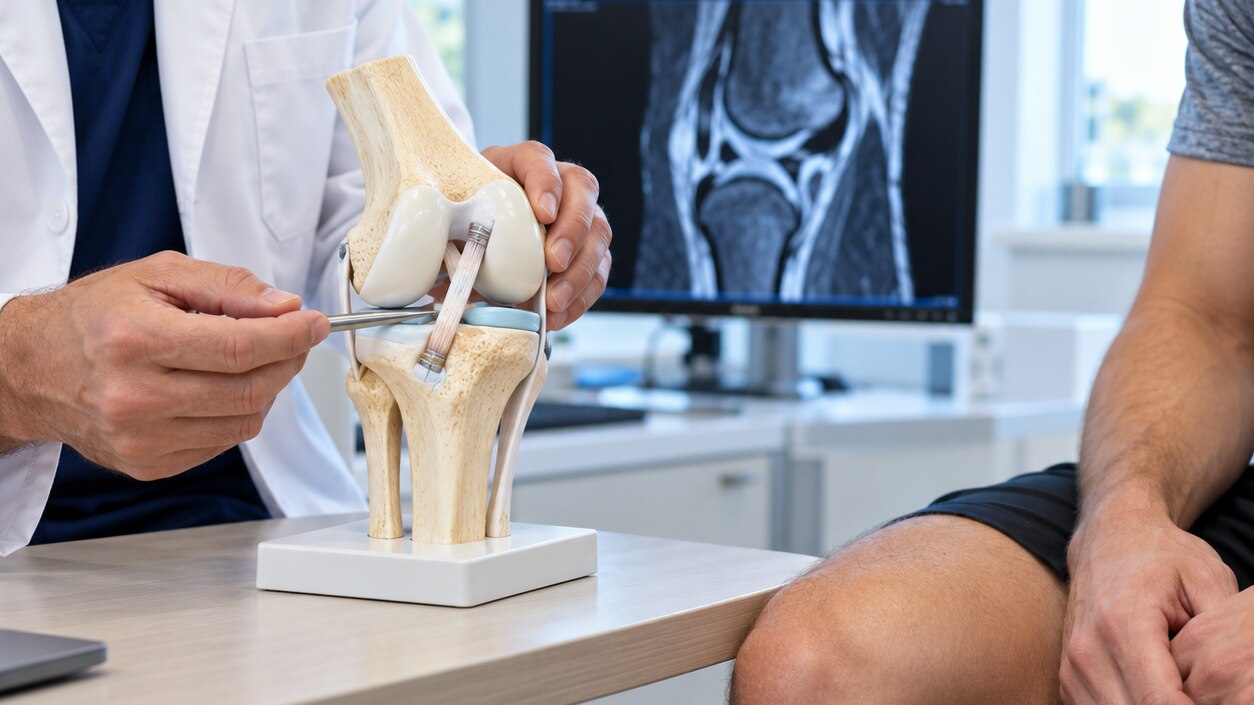
Reconstruction makes sense when knee instability persists, not simply because an MRI shows a tear. The ACL is a strong band in the centre of the knee; its ACL anatomy helps control forward movement and rotation during pivoting and landing. Without it, sudden direction changes can cause the knee to buckle and damage the meniscus.
Doctors confirm the injury through:
- The injury history, including a pop, rapid swelling, and a giving-way episode.
- Lachman and pivot-shift tests, which assess looseness and rotational control.
- Knee X-rays to rule out a fracture or avulsion injury.
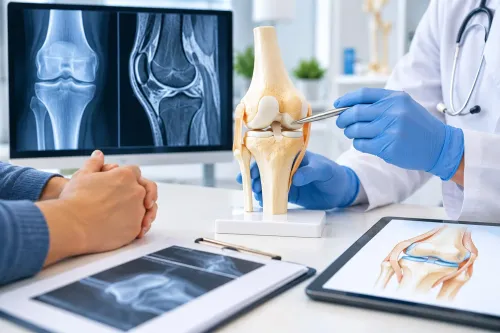
- MRI to show the ACL and identify meniscus, cartilage, or other ligament damage.
The distinction between a complete ACL tear, a partial tear, and a stretched ligament changes treatment planning:
| Grade | Finding | Usual planning |
|---|---|---|
| Grade I | Stretched fibres with little or no looseness | Structured rehabilitation, strength work, and activity modification |
| Grade II | Partial fibre disruption with some looseness | Rehabilitation if the knee remains functional; reconstruction if instability continues |
| Grade III | Complete ACL tear with major or total looseness | Consider reconstruction for recurrent giving-way, pivoting sports, demanding work, or combined injuries |
A stable knee with controlled symptoms can often start with structured rehabilitation without surgery, especially when you do not play pivoting sports. Age, work demands, meniscus damage, and repeated buckling shift the decision toward reconstruction. Medication dosage? It affects pain control, not tear grade or ligament stability.
What to Fix Before Surgery and How to Compare Graft Choices
Before reconstruction, make the knee calm and mobile. Preoperative physical therapy should target swelling reduction, full knee extension, bending motion, normal walking and quadriceps activation; operating on a stiff, swollen knee raises the risk of lasting motion loss.
Use this checklist before surgery:
- Walk without a pronounced limp.
- Straighten the knee fully compared with the other side.
- Control swelling after ordinary activity.
- Contract and raise the leg with the quadriceps without a delay.
- Review meniscus, cartilage or additional ligament injuries that could change weight-bearing rules.
Ask three practical questions: Is medical clearance complete? What does the graft choice comparison show for your age, sport and kneeling demands? What medication dosage is safe with your current prescriptions?
Graft choice changes where soreness and weakness appear, not just the surgical technique.
| Option | Main trade-off | Recovery planning |
|---|---|---|
| Patellar tendon autograft | Strong fixation and low failure risk in many young, active athletes; more anterior-knee or kneeling pain | Protect the harvest site and rebuild knee-extension strength |
| Hamstring autograft | Less kneeling pain; hamstring weakness and graft stretching remain concerns | Add focused hamstring strengthening without neglecting quadriceps work |
| Quadriceps tendon autograft | Large, strong graft with potentially less kneeling pain than patellar tendon | Expect early quadriceps inhibition and progress loading gradually |
| Donor graft (allograft) | No harvest-site wound, but higher failure concern for young athletes in pivoting sports | Discuss donor processing, age-related risk and activity goals before choosing |
At UR Orthopaedic Clinic, take this comparison to the surgeon alongside your sport, work demands, medicines and timeline; no graft is best for every knee.
What Happens During Reconstruction and in the First Six Weeks
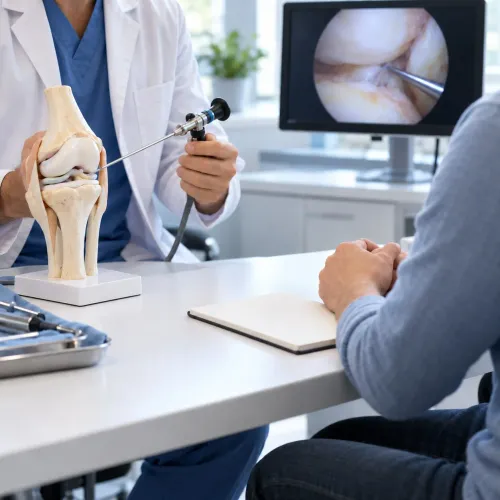
Most ACL reconstructions use anesthesia with a camera and instruments inserted through small incisions. The surgeon performs arthroscopic tunnel preparation in the thighbone and shinbone, passes the graft through those tunnels, and secures it with screws, buttons, or another graft fixation device.
A patellar tendon autograft or hamstring tendon autograft may be used, depending on your anatomy, sport, and surgeon’s plan.
A torn meniscus can be trimmed or repaired during the same operation. Meniscus repair often creates early restrictions: you may need crutches, a brace, limited knee bending, or delayed full weight bearing. Follow those instructions instead of applying an isolated-ACL protocol.
Many isolated ACL reconstructions are same-day surgery, although overnight care is sensible when pain control, nausea, mobility, or another procedure requires observation. Before discharge, confirm the medication dosage and timing, wound-care instructions, brace settings, and emergency symptoms.
During the first six weeks, rehabilitation usually targets:
- Gradual weight bearing and a normal walking pattern
- Full knee extension and steadily improving flexion
- Swelling control and quadriceps activation
- Safe transfers, stairs, bathing, and driving guidance
Pain and stiffness are common during the first days, then should trend downward. Ice, elevation, prescribed medication, and regular exercises help; increasing redness, fever, calf swelling, uncontrolled pain, or drainage needs prompt medical review. Avoid running, jumping, twisting, and carrying heavy loads until cleared.
A Phase-Based Rehabilitation Plan From Motion to Running
Rehabilitation should move from restoring motion and quadriceps activation to loading, running and single-leg control—not follow a calendar blindly. Preoperative therapy targets reduced swelling, full extension and quadriceps control; starting surgery with a stiff, swollen knee raises the risk of lasting motion loss.
- Days 1–14: Prioritise full extension, gradually increasing flexion, controlled swelling, safe weight bearing and a normalising gait. Use quadriceps sets, straight-leg raises when there is no extension lag, and clinician-approved balance work. Confirm medication dosage with your clinician rather than changing it yourself.
- Weeks 2 to 6: Progress cycling, closed-chain exercises and calf, hamstring and hip strengthening as swelling settles. Regain comfortable flexion, keep full extension, and track quadriceps symmetry instead of judging recovery by pain alone.
- Months 2 to 3: Enter the strength phase with progressively heavier squats, split squats, step-downs, leg presses and hamstring work. Add single-leg control through supported single-leg squats, reaches and landing drills; the knee should stay aligned over the foot rather than collapse inward.
- After adequate strength and control: Begin the running phase with walk-jog intervals on a level surface when you have full motion, minimal effusion, a stable gait and sufficient single-leg loading tolerance. Increase only one variable at a time—duration, speed or distance—and stop if swelling or limping returns.
Meniscus repair restrictions can delay weight bearing, flexion or deep squats, so they override a generic ACL rehabilitation timeline. Cartilage or additional ligament procedures require the same caution.
How to Decide When You Are Ready to Return to Sport
A calendar date cannot clear you for cutting and pivoting sports. Return-to-sport testing should show biological recovery, performance, movement control and psychological readiness, not merely completion of a postoperative protocol.
Before clearance, check:
- No or minimal swelling, full knee extension and flexion, and no giving-way during daily activity or training.
- Quadriceps and hamstring strength at least 90–95% of the opposite side, while also comparing absolute force with preinjury or normative results. A normal limb symmetry index can hide weakness in both legs.
- Hop tests, including single-leg, triple, crossover and timed hops, with equal distance or time and controlled landings. A longer hop achieved by avoiding knee loading is not a pass.
- Sport-specific conditioning, deceleration, landing mechanics and progressive cutting drills under fatigue.
| Domain | Evidence to look for | Warning sign |
|---|---|---|
| Movement | Quiet, aligned landings with controlled trunk and hip position | Knee collapse, stiff landing or hesitation |
| Psychology | A satisfactory ACL-RSI scale score and confidence in contact and direction changes | Fear, avoidance or low trust in the knee |
| Preparation | Ongoing injury-prevention training for strength, balance and deceleration | Returning to unrestricted practice without graded exposure |
Medication dosage? It cannot prove readiness, and pain relief must not mask swelling or weakness. Returning to level-I sport before nine months is associated with higher reinjury risk in young athletes, but nine months is not a universal guarantee. Continue prevention work because graft failure and contralateral ACL injury remain possible.
Frequently asked questions
When does an ACL tear require reconstruction surgery?
Surgery makes sense when knee instability persists, especially during pivoting activities, or when associated meniscus or ligament damage affects knee function.
How should you compare ACL graft choices?
Compare autografts and allografts by graft source, recovery demands, complication risks, and how well each option fits your age, activity, and sport.
What happens during the first six weeks after ACL reconstruction?
Early rehabilitation focuses on controlling swelling, restoring full knee extension, regaining quadriceps activation, improving flexion, and progressing from protected walking to stronger movement.
When can you return to running and sport after ACL reconstruction?
Begin running after meeting rehabilitation milestones for motion, swelling, strength, balance, and movement control; return to sport after passing objective strength and functional tests.