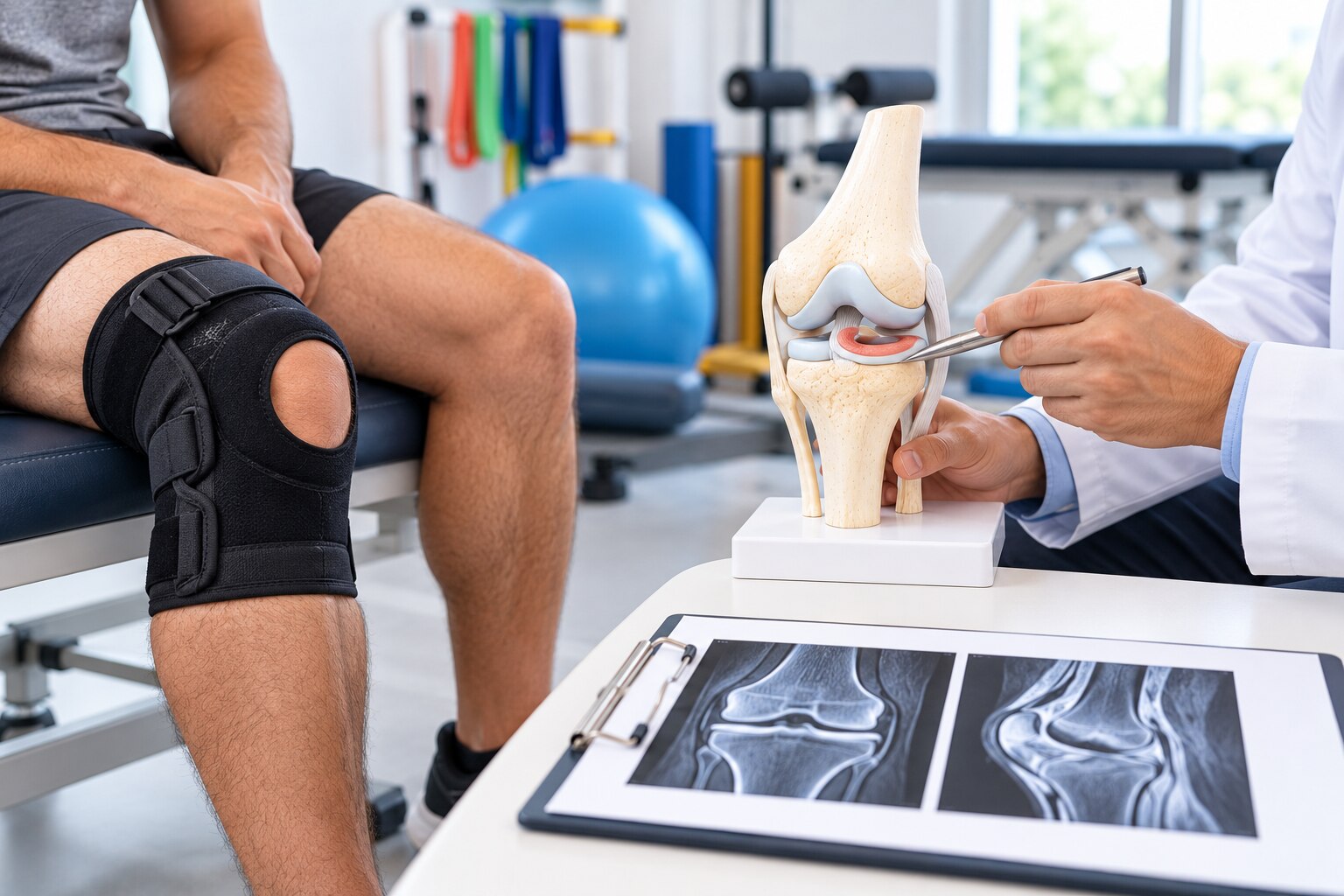
Recovery after meniscus repair depends on the tear pattern, the repair method, and whether procedures such as ACL reconstruction were performed at the same time. You will be able to understand your weight-bearing, brace, motion, exercise, work, driving, and sports restrictions—and recognise when your plan needs review.
Key takeaways
- Your tear pattern and repair stability determine loading and motion limits.
- Root and radial repairs need stricter protection than stable peripheral tears.
- Follow brace, crutch and range-of-motion instructions before increasing activity.
- Contact your surgeon for worsening pain, swelling, fever or calf symptoms.
Your repair type sets the protection plan
A meniscus repair is not a single injury, so rehabilitation differs according to the tear pattern, repair stability and any ACL or cartilage procedure. A stable peripheral vertical-longitudinal tear may tolerate earlier loading than a root or radial repair, which must protect the fixation while tissue heals.
The meniscus repair rehabilitation timeline is therefore set by the operative plan, not a generic calendar.
| Repair type | Early protection | Why it differs |
|---|---|---|
| Stable peripheral vertical-longitudinal repair | Protected or progressive weight bearing; flexion often near 90 degrees | Peripheral tissue has better blood supply and the fixation may be stable |
| Root, radial or complex repair | Brace, crutches and non-weight bearing or very limited loading, often for about 6 weeks | Excess load can pull apart the fixation |
| Repair with ACL or cartilage surgery | Follow the more restrictive combined protocol | The additional procedure changes loading and motion limits |
During the first 48 hours after meniscus repair, expect swelling, pain, a dressing, crutches and a brace if prescribed. Elevate the leg, use ice as directed, move your ankle, and perform only approved quadriceps or range-of-motion exercises; do not test the knee by walking unaided.
Weeks 1 to 2 after meniscus surgery usually focus on wound review, swelling control, full knee extension and safe transfers. Your surgeon may keep the brace locked straight for walking and limit bending to about 90 degrees.
Peripheral meniscus repair recovery can progress faster, but pain, increasing swelling or a blocked knee warrants review rather than extra exercise.
Weight bearing, bracing and motion: what early restrictions mean
The amount of weight you place through the leg depends on the tear and fixation, not on pain alone. Your surgeon’s operative plan overrides any generic definition.
| Level | What it means | How crutches help |
|---|---|---|
| Full weight bearing | You place your normal body weight through the operated leg | They improve balance while strength and walking control return |
| Partial weight bearing | You place only a prescribed share of your weight through the leg | Push through your hands to reduce load; follow the instructed amount |
| Protected weight bearing | You walk with crutches and keep loading low within a surgeon-set limit | They prevent an accidental full step or twist during early healing |
For root, radial, complex, or tenuous repairs, weight bearing after meniscus repair is commonly restricted more strictly. Some stable peripheral repairs progress sooner, so do not increase loading because the knee feels comfortable.
A knee brace protects the repair by limiting unwanted bending and rotation. During walking, a meniscus repair brace locked straight keeps the knee stable; your surgeon may allow it to open for sitting or exercises. Do not unlock it or discard crutches without permission.
A knee flexion 90 degrees after meniscus repair limit avoids deeper bending, where compression and shear rise. Avoid squatting, kneeling, twisting, and loaded flexion even if you can bend farther.
Early exercises protect recovery by maintaining circulation, extension, and muscle control without heavy joint loading:
- Ankle pumps reduce stiffness and support circulation.
- Quadriceps sets restore thigh activation.
- Straight-leg raises maintain strength only when you can lift without the knee sagging.
Pain, swelling, or loss of extension after exercise means the load needs review.
Weeks 3 to 6 and later: rebuilding strength safely
By week 3, the priority is a fully straight knee and reliable quadriceps control, not heavier weights. Persistent loss of extension changes walking mechanics and can delay strengthening.
During weeks 3 to 6 meniscus repair rehabilitation, your therapist gradually advances range of motion after meniscus repair, walking, and resistance according to the tear pattern and surgeon’s restrictions.
Safe meniscus repair strengthening exercises commonly progress through:
- Quadriceps sets and straight-leg raises, provided you can keep the knee fully straight without a lag
- Bridges, hip abduction and calf raises to maintain support from the hip and ankle
- Mini-squats, step-ups and controlled single-leg work once swelling stays settled and the repair permits deeper loading
Stationary cycling is added when you can pedal smoothly without forcing flexion or increasing swelling. Begin with low resistance; a blocked pedal stroke is a reason to wait, not push harder.
The question of when to start running after meniscus repair has a criteria-based answer. Clinicians look for near-full motion, no significant effusion, normal walking, controlled single-leg squats or landings, and substantial quadriceps recovery. Some programmes introduce a gradual jog around 12 weeks; root, radial or complex repairs often require longer protection.
Higher-load lifting, jumping and pivoting drills come after strength testing, movement control and sport-specific practice—not simply because a calendar date has arrived. Pain, swelling or loss of extension after exercise means the load advanced too quickly.
When everyday and sports activities become realistic
Driving after meniscus repair is realistic when you can enter and exit safely, control the knee, perform an emergency stop, and take no sedating pain medicine. This often means about 2–6 weeks; a right-knee repair can take longer than a left-knee repair.
Desk work is often possible within 1–2 weeks if you can elevate the leg and manage swelling. Stairs, kneeling and squatting after meniscus repair require different milestones:
- Stairs: use the rail and prescribed crutch pattern first; climb normally when you can control the knee without pain, buckling, or a limp.
- Kneeling: delay until the incision is healed and pressure is comfortable, often at least 8–12 weeks.
- Squatting: begin shallow, unloaded squats only after your clinician permits deeper flexion; avoid heavy or deep squats while healing continues.
- Cycling: start with a stationary bike when you have sufficient motion, commonly around 4–6 weeks; add resistance gradually.
- Swimming: wait until wounds are fully closed and your clinician approves immersion, often around 4–6 weeks; avoid forceful breaststroke kicking initially.
- Weight training: begin controlled, low-load exercises before progressing to heavier loads; postpone deep loaded knee flexion.
- Running: start only after full motion, no swelling, strong single-leg control, and a graded jogging programme—often around 3–4 months.
- Return to sport after meniscus repair: unrestricted cutting and pivoting commonly wait 4–6 months or longer, with strength and hop performance near 90% of the other leg.
How to judge progress—and when to contact your surgeon
Progress is safe when the knee has full extension, controlled swelling, near-normal walking, and quadriceps strength symmetry after meniscus repair, not simply because a certain number of weeks has passed. Increase one demand at a time; pain or swelling that settles by the next day usually signals workload intolerance, not automatic repair failure.
| Status | What it means | Next step |
|---|---|---|
| Full motion, minimal effusion, steady gait | The knee is tolerating current activity | Progress only the exercise or load approved by your surgeon |
| Weak quadriceps, altered landing, or swelling after exercise | Control is not ready for higher impact | Reduce the load and review technique with your physiotherapist |
| Hop testing, landing control, and strength at about 90% of the opposite side | A common minimum before sport progression | Add sport-specific drills before unrestricted play |
Track meniscus repair swelling and locking in a daily log. Contact your surgeon for recurrent or increasing effusion, new catching or locking, lost extension, giving way, fever, wound drainage, or calf swelling. Do not push through these signs.
An MRI after meniscus repair is not a pass-or-fail healing certificate. Persistent signal changes and irregularity can remain, so clinicians interpret imaging with your symptoms, examination, and performance; routine MRI does not clear an asymptomatic athlete for sport.
At UR Orthopaedic Clinic, personalised follow-up can match examination findings and rehabilitation tests to the operative report, tear pattern, repair stability, and associated procedures. That prevents a generic timeline from overriding restrictions specific to your knee.
Frequently asked questions
Why do rehabilitation restrictions differ after meniscus repair?
The protection plan depends on the tear pattern, repair stability and additional procedures such as ACL or cartilage surgery.
What do early weight-bearing, bracing and motion restrictions mean?
They limit force and bending across the repair while it heals; use crutches, a brace and the permitted motion range exactly as instructed.
When can you rebuild strength after meniscus repair?
Strength work progresses after the protected phase, with exercise intensity guided by healing, swelling, movement and your surgeon’s plan.
When can everyday and sports activities become realistic?
Everyday activity returns before cutting, pivoting and impact sports; resume each stage only when strength, control, motion and symptoms support it.
When should you contact your surgeon during recovery?
Report worsening pain or swelling, fever, wound problems, a locked knee, new calf pain or breathlessness promptly.