A painful vertebral fracture does not automatically make kyphoplasty the right treatment. By the end, you will know which findings confirm the fracture as your pain source, how kyphoplasty compares with other options, and what to ask about safety, preparation, recovery and future fracture prevention.
Key takeaways
- Confirm MRI evidence of a painful, recent vertebral compression fracture.
- Ask how kyphoplasty compares with vertebroplasty and non-surgical care.
- Discuss cement leakage, nerve injury, infection and anaesthesia risks.
- Plan transport, medication instructions and activity restrictions before the procedure.
How does kyphoplasty work, and how is it different from vertebroplasty?
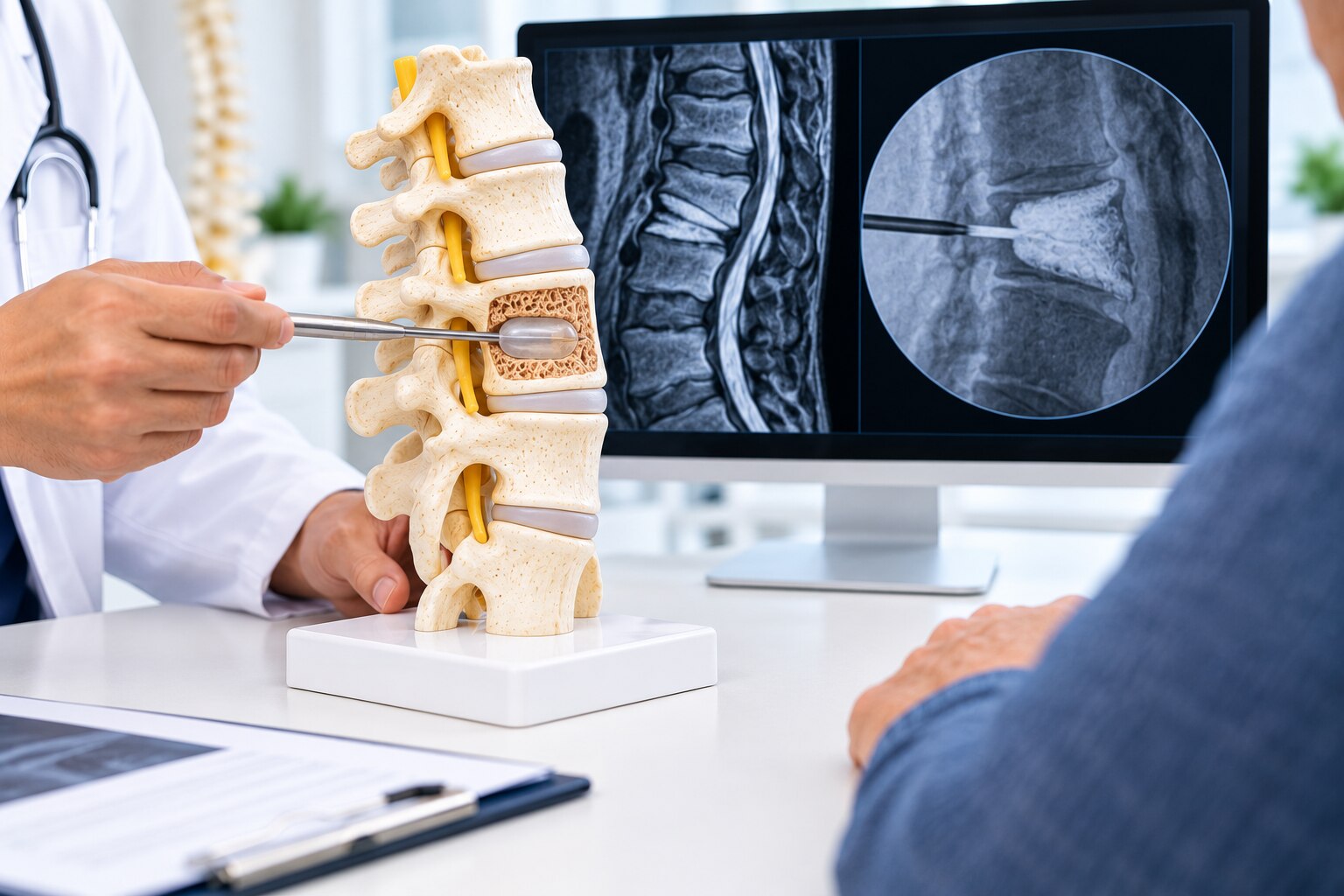
A kyphoplasty procedure uses fluoroscopy or CT guidance to treat a painful collapsed vertebra. The operator passes a narrow instrument through the pedicle into the vertebral body, inflates a small balloon to create a cavity and sometimes partially restore vertebral height, then fills the cavity with bone cement.
A straighter vertebra on an X-ray does not guarantee normal spinal function or pain relief.
Kyphoplasty and vertebroplasty differ in how cement enters the bone. Balloon kyphoplasty creates a cavity first; vertebroplasty injects cement directly without balloon expansion. A cavity can improve cement control, but leakage outside the vertebra remains possible.
Your clinician may compare them using the fracture shape, degree of collapse, kyphotic angulation, cement-control needs and evidence that applies to your case.
| Option | What happens | Why it may be considered |
|---|---|---|
| Kyphoplasty | Balloon creates a cavity before cement injection | Collapse or kyphotic angulation needs assessment |
| Vertebroplasty | Cement enters directly without balloon expansion | Direct treatment fits the fracture pattern |
| Neither | Non-operative care or another operation | The fracture pattern or symptoms do not fit augmentation |
- Painful acute or subacute osteoporosis-related compression fractures
- Selected cancer-related vertebral damage
- Selected traumatic compression fractures
An abnormal X-ray alone is not enough. Kyphoplasty may not fit a painless, healed, infected or neurologically compressive fracture, or an unstable burst fracture. It treats pain from the fracture, not osteoporosis itself; bone-fragility treatment still needs separate assessment.
What evidence would show that kyphoplasty is suitable for my pain?
Kyphoplasty fits pain linked to a recent, painful vertebral compression fracture—not an abnormal X-ray alone. Ask the clinician to work through this checklist:
1. Is the pain focal, severe and reproducible at the suspected vertebral level? Does it prevent sleep or walking despite prescribed analgesics, activity modification and mobilisation?
2. Do standing X-rays show alignment and vertebral collapse? Ask for the fracture age, vertebral level and vertebral collapse percentage or description where reported.
3. Does MRI show recent MRI marrow oedema at that level, while excluding spinal stenosis, disc disease, infection or malignancy? Ask how the painful level was confirmed, especially if several fractures appear on scans.
4. What does CT show about the posterior vertebral wall, pedicles, fracture line and canal compromise? Posterior-wall disruption or significant canal narrowing can require specialist planning rather than straightforward cement augmentation.
5. Has osteoporosis been assessed, including prior fractures and secondary causes of bone loss? An old, healed fracture or a painless fracture does not provide the same rationale because it may not explain current symptoms.
Seek urgent assessment for new leg weakness, saddle numbness, bladder or bowel changes, fever, unexplained weight loss, a cancer history or severe trauma. These findings can indicate nerve compression, infection, malignancy or an unstable injury rather than an uncomplicated fracture.
What should I compare with kyphoplasty before deciding?
A trial of non-operative care targets different problems and improvement may take days to weeks, not happen immediately.
| Option | Intended improvement | Important limit |
|---|---|---|
| Analgesics | Target fracture pain | Do not repair the fracture |
| Short-term brace | Support comfort during movement | Prolonged use can restrict conditioning |
| Mobilisation plan | Limit bed-rest deconditioning | Increase activity within safe limits |
| Physiotherapy | Rebuild movement and strength | Progress depends on pain and stability |
| Fall prevention | Reduce another injury | Does not mend the existing fracture |
| Calcium and vitamin D review | Correct inadequate intake or levels | Does not instantly heal the fracture |
| Prescribed osteoporosis medicine | Reduce future fracture risk over time | Does not instantly mend the current fracture |
Ask what has been tried and why it is no longer adequate. A short-term brace, analgesics, a mobilisation plan and physiotherapy may be reasonable before intervention when pain allows.
Decompression or instrumented fixation addresses a different problem when there is neurological deficit, spinal instability, major deformity or canal compromise. Cement augmentation alone cannot remove pressure from nerve tissue or stabilise every unstable fracture.
There is no universal mandatory waiting period. The decision depends on persistent fracture-related pain and impaired function, not a calendar deadline.
Ask:
- What benefit do you expect from kyphoplasty?
- How long will you reassess non-operative care?
- What finding would change the plan?
- What kyphoplasty evidence applies to my case?
Evidence is not identical across vertebral augmentation procedures, so do not assume results for vertebroplasty or other cement procedures automatically apply to kyphoplasty.
What risks and practical safeguards should I discuss with the operator?
Cement leakage is the main procedure-specific hazard. Cement can escape outside the vertebral body; much leakage is visible only on imaging and causes no symptoms, but leakage into the spinal canal can injure nerves, while leakage into veins can rarely cause pulmonary cement embolism.
Ask for the operator’s own observed leakage, neurological-injury and embolism rates, not only a general claim that kyphoplasty is minimally invasive.
Other risks include persistent or worsening pain, infection, bleeding, rib or pedicle injury, allergic or anaesthetic reactions, nerve or spinal cord injury, cardiovascular or respiratory complications, and an adjacent-level fracture. A new fracture does not automatically prove kyphoplasty caused it; continuing osteoporosis remains a major concern.
Ask these procedure-specific questions:
- Which imaging guidance will you use: fluoroscopy, CT, or both?
- What cement type and planned volume will you use?
- What will you do immediately if leakage appears?
- What symptoms after treatment require urgent review, and whom should I contact?
| Decision point | Question to ask | Why it matters |
|---|---|---|
| Anaesthesia plan | Will I have local anaesthetic with sedation or general anaesthesia? | Preparation, monitoring and discharge rules differ |
| Medication preparation | When must I stop blood thinners and diabetes medication, and what glucose instructions apply? | Incorrect changes can cause bleeding or unsafe glucose levels |
| Discharge | Do I need transport home, overnight observation, or a responsible adult staying with me after sedation or anaesthesia? | Sedation can impair judgement, balance and memory |
Also ask about fasting times and pre-anaesthesia tests.
What will recovery involve, and how should I prepare for the consultation?
Kyphoplasty recovery often allows walking later the same day or the next day once cleared, but puncture-site soreness can last several days. Keep dressings clean and dry, follow the team’s exact bathing instruction, avoid lifting and repeated bending until released, and do not drive while taking sedating medicine or until emergency braking is comfortable.
Get a dated return-to-work plan: desk work may resume after clearance, while lifting or physical work needs a staged plan.
Fracture pain can improve quickly; muscle pain, spinal stenosis, disc disease and deconditioning can persist. Follow-up imaging is needed when symptoms, examination or healing concerns warrant it. Contact the treating team urgently for new leg weakness or numbness, bladder or bowel changes, fever, chest pain, breathlessness or worsening back pain.
1. Suitability: Ask how imaging confirms the painful level and fracture age, and whether MRI or CT is recent. Neurological symptoms or severe trauma require urgent assessment; a stable suspected osteoporotic fracture allows planned imaging and review.
2. Alternatives: Ask what non-operative care has achieved and what result would change the plan.
3. Risks: Ask about cement leakage, anaesthesia, infection and adjacent fracture.
4. Preparation: Bring X-rays, MRI or CT discs and reports, medication and anticoagulant name and dose, allergies, and osteoporosis and fracture history.
5. Recovery: Count imaging, pre-anaesthesia tests, medication review, transport, observation, follow-up and rehabilitation costs.
6. Long-term fracture prevention: Ask about anti-osteoporosis treatment separately after deciding on the procedure. For uncertainty, multilevel treatment, cancer, neurological symptoms or no recent MRI/CT, seek a second opinion for kyphoplasty. UR Orthopaedic Clinic can review these records, but assessment establishes suitability.
Frequently asked questions
How does kyphoplasty differ from vertebroplasty?
Kyphoplasty uses a balloon to create a cavity before bone cement is injected; vertebroplasty injects cement directly into the compressed vertebral body without balloon inflation.
What evidence shows that kyphoplasty may suit my pain?
Ask whether MRI findings identify a recent vertebral compression fracture that matches your pain, examination and symptoms. Discuss other causes of back pain before deciding.
What should I compare with kyphoplasty?
Compare kyphoplasty with pain medicines, activity modification, physiotherapy, osteoporosis treatment and vertebroplasty. The appropriate choice depends on fracture age, pain severity, stability and your health.
What risks should I discuss with the operator?
Ask about cement leakage, nerve or spinal cord injury, infection, bleeding, anaesthesia complications, blood clots, new vertebral fractures and the chance that pain will persist.
What does recovery from kyphoplasty involve?
Ask when you can walk, drive, work, lift objects and restart exercise. Arrange transport, follow medication instructions and clarify warning signs that require urgent medical review.